
Aerial Application of Biostimulant Inputs Using Drones: Potential and Current Barriers
Modern agriculture is moving towards more efficient and sustainable systems, where aerial application using drones is becoming a key tool in precision farming. This technology helps optimise input use, reduce costs, and minimise environmental impact, although its implementation still presents technical and regulatory challenges.
Technical Advantages of Drone Application
- Uniformity and precision: Drones allow for homogeneous and localised distribution, adjusting doses according to vigour maps (NDVI) and agronomic data.
- Reduced drift: Thanks to low flight altitude and specialised nozzles, losses due to wind are minimised.
- Resource optimisation: Lower water consumption and reduced emissions compared with ground machinery.
- Accessibility: Ideal for crops in areas with difficult access or steep slopes.
Technical and Regulatory Barriers
- Limited payload capacity: Most agricultural drones can carry between 10 and 40 litres. Although recent models have higher capacities, efficiency remains constrained in large-scale farms.
- Formulation compatibility: Not all inputs are designed for aerial application; products require low viscosity and high stability.
- Aviation regulations: Strict rules regarding flight operations, distances, and safety.
- Cost and training: High initial investment and the need for certified pilots.
- Environmental conditions: Wind, temperature and humidity can affect application quality.
Bioiberica’s Experience with Biostimulant Application
Bioiberica has developed formulations adapted to the requirements of aerial application, ensuring efficacy and safety. In trials carried out in large-scale crops such as soybeans and maize, the following results were observed:
- Physical and chemical compatibility: Biostimulants such as Terra‑Sorb® foliar, AminoQuelant®, and Terra‑Sorb® complex show excellent miscibility and stability in aerial spraying equipment.
- Agronomic efficiency: Applications at critical stages (water stress, high metabolic demand) have shown increases in vigour and yield comparable to ground application.
- Reduced operational costs: Shorter application time and fuel savings compared with conventional machinery.
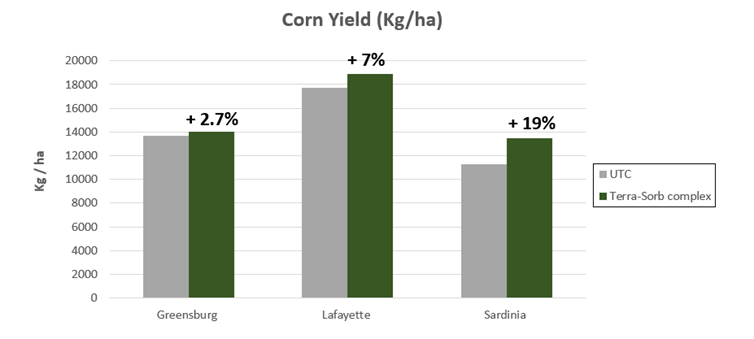
- Field results: Trials in Indiana (USA) with Terra‑Sorb® complex (1.2 L/ha) applied via drone showed average yield increases of 1,220 kg/ha and an ROI of 29.
Conclusion
Aerial application by drone represents a strategic opportunity for more sustainable agriculture. Bioiberica Plant Health, through innovation in biostimulants and tailored protocols, is driving this technological transition.